
Resilience by design: leadership lessons from Hong Kong’s climate challenge
Posted on: 2026-09-08
By Dr Claire Hookham
Associate Professor of Management and Business Education and MBA Programme Leader, University of the Built Environment
When most people think about climate change, they picture environmental challenges: rising temperatures, extreme weather, and flooding. Increasingly, however, climate change is also becoming a leadership challenge.
Few cities demonstrate this more clearly than Hong Kong.
In recent years, Hong Kong has experienced a succession of extreme weather events, including record-breaking rainfall, severe flooding, powerful typhoons, and increasing climate volatility. The Hong Kong Observatory reports that extreme precipitation events have become more frequent, while temperatures continue to rise and weather patterns become increasingly unpredictable. Yet, what makes Hong Kong particularly interesting is not simply the scale of the challenge. It is how the city is responding.
For professionals working across the built environment, Hong Kong offers a powerful lesson in resilience, systems thinking, and long-term strategic leadership.
Building resilience before disaster strikes
One of the most valuable leadership lessons from Hong Kong is that resilience cannot be built during a crisis. It must be designed long before one occurs.
Following major weather-related disruptions, including the devastating rainfall events of 2023 and subsequent extreme storms, Hong Kong has significantly increased investment in drainage infrastructure, flood management, coastal protection, and climate adaptation measures. Billions of dollars are now being directed towards strengthening the city’s resilience to future climate threats.
The Government’s Climate Action Plan 2050 explicitly recognises that adaptation is now as important as decarbonisation. The strategy focuses on strengthening infrastructure, improving flood resilience, enhancing coastal protection, stabilising slopes, and preparing communities for more frequent extreme weather events.
For leaders, the message is simple: resilience is not a reactive capability. It is a strategic investment. The organisations that thrive in uncertain environments are rarely those that respond best to crises. More often, they are the organisations that prepared for them years in advance.
The Importance of systems thinking
Climate resilience is not simply an engineering challenge.
Flooding affects transport networks. Transport disruption affects economic productivity. Infrastructure failures affect public services, communities, and businesses. Every element is connected.
Leadership within complex environments increasingly requires systems thinking: the ability to understand how decisions in one area create consequences elsewhere.
Hong Kong’s climate adaptation strategy is built around this principle. Rather than focusing on individual projects in isolation, planners are increasingly taking an integrated approach that considers drainage systems, coastal infrastructure, urban design, emergency response, transportation networks, and future development together.
For professionals in construction, surveying, engineering, property, and infrastructure management, this mirrors the reality of modern practice.
The challenges facing built environment leaders are rarely technical problems with technical solutions alone. They are interconnected challenges involving multiple stakeholders, competing priorities, uncertain futures, and complex systems.
Leadership under uncertainty
Perhaps the most difficult aspect of climate resilience is making decisions when the future remains uncertain.
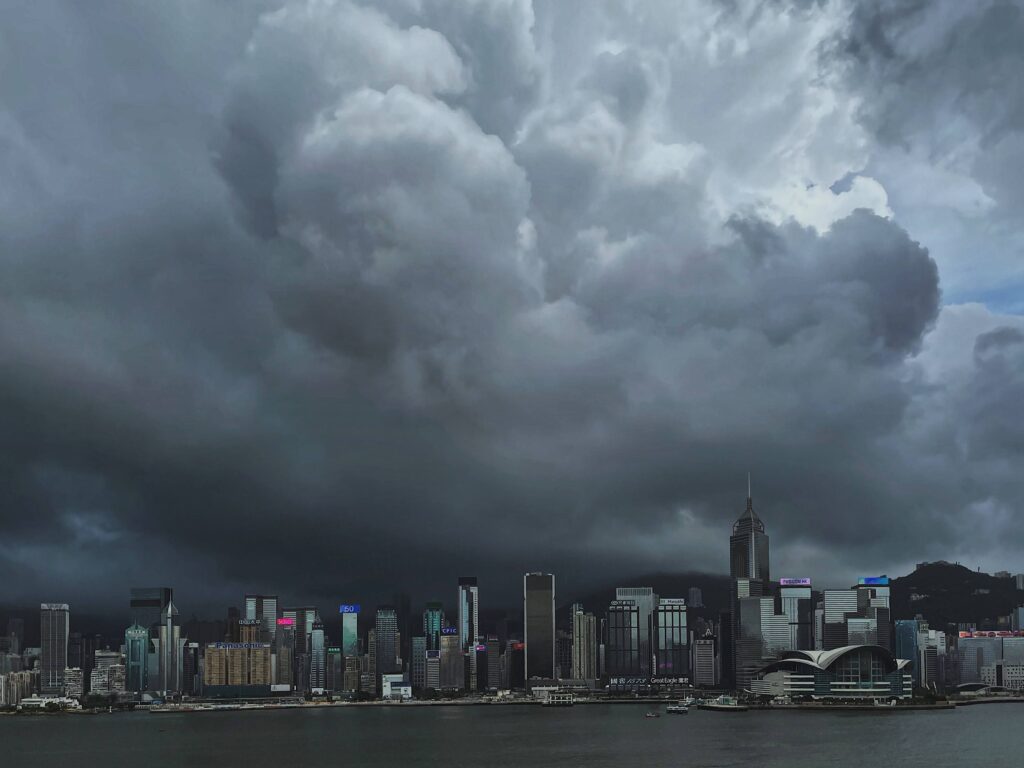
No leader knows precisely when the next extreme rainfall event will occur. No planner can predict exactly how climate risks will evolve over the next thirty years. Yet decisions still need to be made. Recent climate research suggests that Hong Kong faces increasing exposure to intense rainstorms, flooding events, and climate-related disruption. As a coastal city with dense urban development and significant hillside infrastructure, these risks are particularly complex.
Strategic leaders must therefore become comfortable operating in uncertain environments. Rather than seeking perfect information, they must evaluate risk, consider alternative scenarios, allocate resources effectively, and make decisions that remain robust under multiple future conditions. This capability is becoming increasingly important across all sectors, not only the built environment.
Balancing investment and value
A common criticism of resilience initiatives is cost. Drainage tunnels, flood barriers, climate adaptation measures, and resilient infrastructure require significant investment. The benefits may not be immediately visible. In fact, successful resilience often appears invisible because disasters are avoided rather than experienced. This creates a familiar leadership dilemma.
How do you justify major expenditure today for risks that may materialise decades from now? The answer lies in long-term value creation.
Hong Kong’s approach demonstrates that resilience should be viewed not as a cost but as an investment in economic continuity, organisational stability, community wellbeing, and future growth. Recent infrastructure upgrades have already helped minimise the impacts of subsequent extreme rainfall events compared with previous years.
The same principle applies in business. Effective leaders look beyond immediate financial returns and consider long-term sustainability, risk exposure, and organisational resilience.
What this means for built environment professionals
For professionals working across Hong Kong’s built environment sector, these challenges are highly relevant.
Whether you work in construction, project management, real estate, infrastructure delivery, engineering, or urban development, climate resilience is increasingly shaping strategic decision-making.
Future leaders will need to understand more than technical design standards. They will need the ability to manage uncertainty, evaluate risk, influence stakeholders, develop strategy, and lead organisational change. These are fundamentally leadership skills. They require professionals to think beyond projects and consider the wider social, economic, environmental, and organisational systems in which they operate.
The MBA perspective
This is precisely why leadership development matters. At the University of the Built Environment, our MBA has been designed for ambitious professionals seeking to move into senior leadership roles within construction, real estate, infrastructure, and related sectors. The programme develops strategic management, leadership, innovation, finance, entrepreneurship, and decision-making capabilities within a built environment context.
Importantly, our students explore real-world challenges like climate resilience, sustainability, infrastructure investment, and organisational transformation. Through engagement with an international network of professionals, they develop the skills needed to lead complex organisations operating in uncertain and rapidly changing environments. Students who complete the programme are also eligible for the CMI Level 7 qualification in Strategic Management and Leadership Practice.

Looking ahead
Hong Kong’s climate challenge is ultimately a leadership challenge.
The city’s response demonstrates that resilience is not simply about infrastructure. It is about vision, systems thinking, collaboration, investment, and strategic decision-making under uncertainty.
As climate risks continue to grow, the most successful organisations will not necessarily be those with the strongest assets. They will be those with the strongest leaders…and that may be the most valuable lesson Hong Kong has to offer.

 EN
EN  ZH
ZH