
Caring neighbourhoods: Planning for ageing, connection and everyday life
Posted on: 2026-10-02
Neighbourhoods are not simply places where ageing happens. They actively shape whether people can continue living the lives they value.
Dr Hannah Grove, Lecturer in Urban Planning, University of the Built Environment
How would you define a good quality of life?
Perhaps it’s spending time at home, meeting a friend for coffee, browsing the local shops, attending a community group or simply going for a walk in your local park. These everyday moments are often what give our lives meaning, yet we rarely stop to think about what makes them possible. The quality of our home, the ease of moving through our neighbourhood, the availability of local services and green spaces, and the opportunities to connect with others all shape how we experience everyday life.
The question of what constitutes a good quality of life has shaped my research on ageing and place. The older people I have interviewed consistently describe living and ageing well as being able to continue engaging with the people, places and routines that matter most to them.
One of these participants was Dolores (not her real name), an 89-year-old woman living alone in suburban Dublin. For Dolores, a “good day” meant being able to walk independently to morning Mass at her local church. The journey was about 800 metres from her home, yet it required careful planning. Using a walker, Dolores constantly balanced her health and energy levels with changing weather conditions and uneven pavements. On good days she completed the walk, on others, the risks felt too great. Over time, negative experiences with using public transport, combined with falls and periods of hospitalisation, reduced the range of places she felt able to visit, limiting both her activity space and opportunities for social connection.
Dolores’ story highlights an important lesson for planners: neighbourhoods are not simply places where ageing happens. They actively shape whether people can continue living the lives they value.
Ageing Well in Place
Governments worldwide are encouraging people to age in place by remaining in their own homes and communities for as long as possible. Traditionally, this has focused on adapting housing and providing care services that can help older people remain independent.
But ageing well is about much more than what happens within the home.
Research consistently shows that a good quality of life in later life depends on the ability to leave home, remain mobile and participate in community life. Visiting friends, shopping locally, attending religious services, or simply enjoying a walk all contribute to independence, purpose and wellbeing. In many ways, how easily someone can engage with their neighbourhood is a better indicator of ageing well than simply remaining at home.
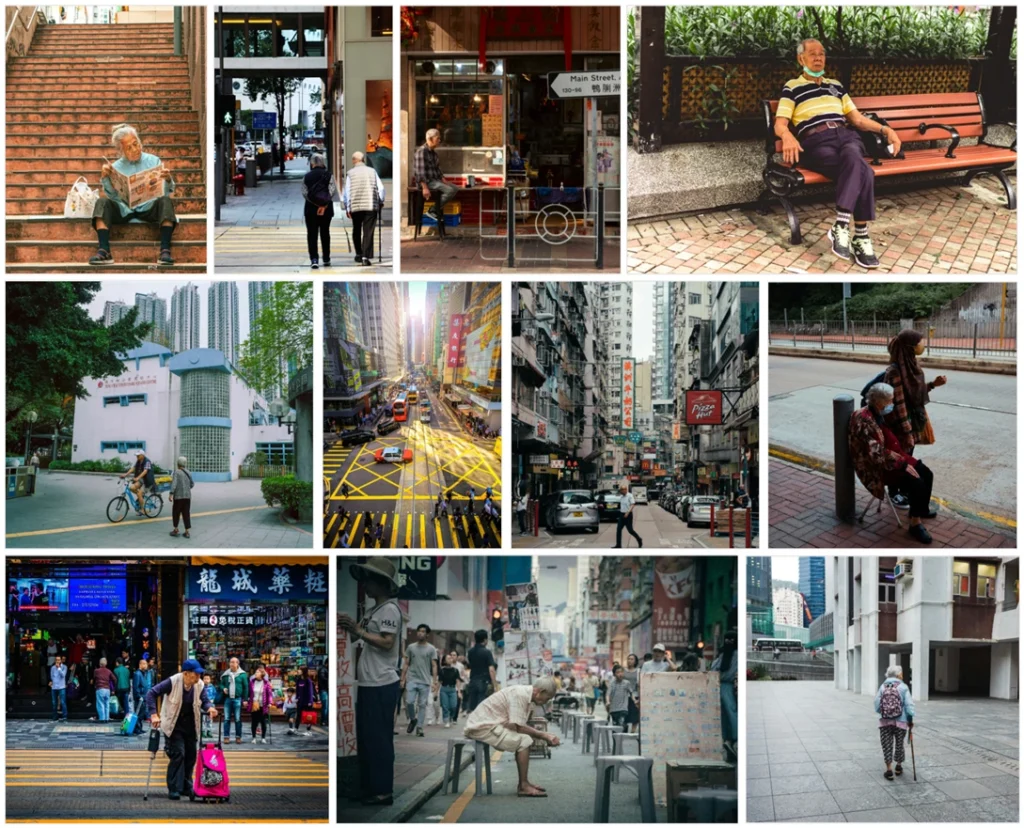
These questions are becoming increasingly important in Hong Kong, one of the world’s most densely populated cities. Population ageing is accelerating rapidly. By 2039, around 31% of the population will be aged 65 or over, while 11.5% will be aged 80 or above. At the same time, Hong Kong faces what is often referred to as ‘double ageing’, with an ageing population alongside ageing housing estates and neighbourhoods.
Although Hong Kong has one of the highest life expectancies in the world and has made significant progress in promoting age-friendly communities since joining the WHO Global Network for Age-friendly Cities and Communities in 2017, the everyday realities of ageing vary considerably. For many older residents, excellent public transport, compact neighbourhoods and nearby services can support independence, social participation and community mobility. For others, particularly those living alone, experiencing poverty or chronic health conditions, living in ageing or substandard housing, or continuing to work beyond retirement age, everyday life can be considerably more challenging [1] and may limit opportunities to remain active, socially connected and independent.
The challenge for policymakers is therefore not simply whether older people can age in place, but whether the places in which they are ageing support them to age well.
Moving beyond a checklist
The World Health Organization’s Age-friendly Cities and Communities framework has been highly influential in shaping our understanding of ageing and the role of place in supporting later life. Its eight domains, which include housing, transport, outdoor spaces and social participation, provide a useful framework and checklist for creating more inclusive places.
However, these checklists tell us what neighbourhoods contain, not necessarily how they are experienced.
A neighbourhood may have accessible housing, public transport and local shops within walking distance.
But does an older person feel confident enough to make this journey?
Most importantly, experiences of place are shaped by existing inequalities. Age-friendly environments can look very different depending on a person’s health, income, mobility and social supports, and whether they have resources to overcome a more unsupportive neighbourhood.
Rethinking planning evidence
Planning has traditionally relied on evidence such as demographic projections, housing need, transport modelling and more objective accessibility measures. These remain essential. But many of the qualities that determine whether neighbourhoods support people to thrive are much harder to measure.
How do we measure a sense of belonging, or whether neighbours know one another well enough to notice when someone has not been seen for several days? How do we understand whether a local café, library or community centre gives someone a reason to leave home each morning?
These more intangible aspects of neighbourhood life often matter most to older people themselves, yet they rarely feature within planning evidence. [2] [3]
My research argues that we need to broaden what counts as evidence by placing greater value on lived experience. Creative and participatory approaches, including go-along interviews and spatial storytelling can allow planners to experience neighbourhoods alongside older residents, revealing barriers, opportunities and aspirations that conventional datasets can easily overlook. Older people who are socially isolated, have limited mobility or financial resources, or rarely leave home are often less able to participate in consultation processes. Yet it is these individuals who can provide some of the most valuable insights into how neighbourhoods can better support later life.
Designing caring neighbourhoods
These ideas are explored in greater depth in a new book chapter, Caring Neighbourhoods for Ageing Well in Place, published in Care, Health and Housing: Crisis, Experiences and Answers, an edited collection by Associate Professor Lidia Manzo. Bringing together contributions from international researchers and practitioners, the book argues that housing (and the broader neighbourhood) should be understood as a vital infrastructure of care that shapes wellbeing, dignity and social justice, as well as offers practical ideas for creating healthier and more equitable communities.
Care is not only provided through health and social care services. It is also embedded within the everyday environments that support daily life: neighbours who check in during bad weather, bus drivers who wait while someone boards safely, well-maintained pavements, benches that make longer journeys possible, and local shops, libraries and community facilities located together to help people remain connected.
These everyday places form what sociologist Eric Klinenberg describes as social infrastructure, the physical spaces that enable relationships, trust and community life to develop. They are just as important to healthy ageing as housing or healthcare, yet they are often undervalued within planning.
Urban planning has a fundamental role in creating infrastructures of care. It shapes the quality of housing, the walkability of streets, access to public transport, the provision of community facilities and, ultimately, whether people can continue doing the activities that give meaning and purpose to their lives.
As populations across the world continue to age, planning for ageing well will require a stronger focus on reducing inequalities and broadening our understanding of what makes a neighbourhood supportive. As outlined in the chapter, this means integrating planning more closely with public health, recognising neighbourhoods as infrastructures of care, investing in everyday mobility and social infrastructure, and placing lived experience alongside traditional forms of planning evidence.
Together, these ideas offer a more holistic and inclusive approach to planning. By placing care, social connection, and lived experience at the centre of placemaking, this approach can help create neighbourhoods that support wellbeing, reduce inequalities, and enable people to thrive throughout their lives.
Want to learn more?
Find out more about the University of the Built Environment’s MSc Urban Planning
[1] Phillips, D. R., Woo, J., Cheung, F., Wong, M., & Chau, P. H. (2018). Exploring the age-friendliness of Hong Kong: opportunities, initiatives and challenges in an ageing Asian city. In T. Buffel, S. Handler, & C. Phillipson (Eds.), Age-friendly cities and communities: A global perspective (1st ed., pp. 119–142). Bristol University Press. [2] van Hees, S., Horstman, K., Jansen, M., and Ruwaard, D. (2017) Photovoicing the neighbourhood: Understanding the situated meaning of intangible places for ageing-in-place. Health and Place, 48(Supplement C), 11–19. [3] Hockey, A., Phillips, J., and Walford, N. (2013) Planning for an Ageing Society: Voices from the Planning Profession. Planning Practice and Research, 28(5), 527–543.

 EN
EN  ZH
ZH